Mar
12
7:00 PM19:00

Tracing the Midwest Fur Trade with Archaeological Chemistry

It’s time for another Charles E. Brown presentation! Register at https://wihist.org/CEB-Mar26 to join us for our first presentation of 2026!

 Tracing the Midwest Fur Trade with Archaeological Chemistry

Please join Dr. Heather Walder of UWL Department of Archaeology and Anthropology as she gives us a new look at the Fur Trade.

During the seventeenth to early nineteenth centuries, European and Euro-American fur traders brought exchange items, including vermilion pigment (mercury sulfide, HgS), as gifts and payments to their Indigenous trade partners around the Great Lakes region. The speaker will share results from an interdisciplinary project testing soil samples from the AD 1793-1835 Northwest Company and American Trade Post archaeological site on Madeline Island, Wisconsin. The mapped results of this collaborative study help better understand fur trade activities in the Midwest and identify potential areas of future archaeological investigation on Mooningwanekaaning, an island still sacred to Ojibwe descendants today.

View Event →
Mar
20
6:00 PM18:00

Wisconsin Shipwreck Coast Film Screening Event Information

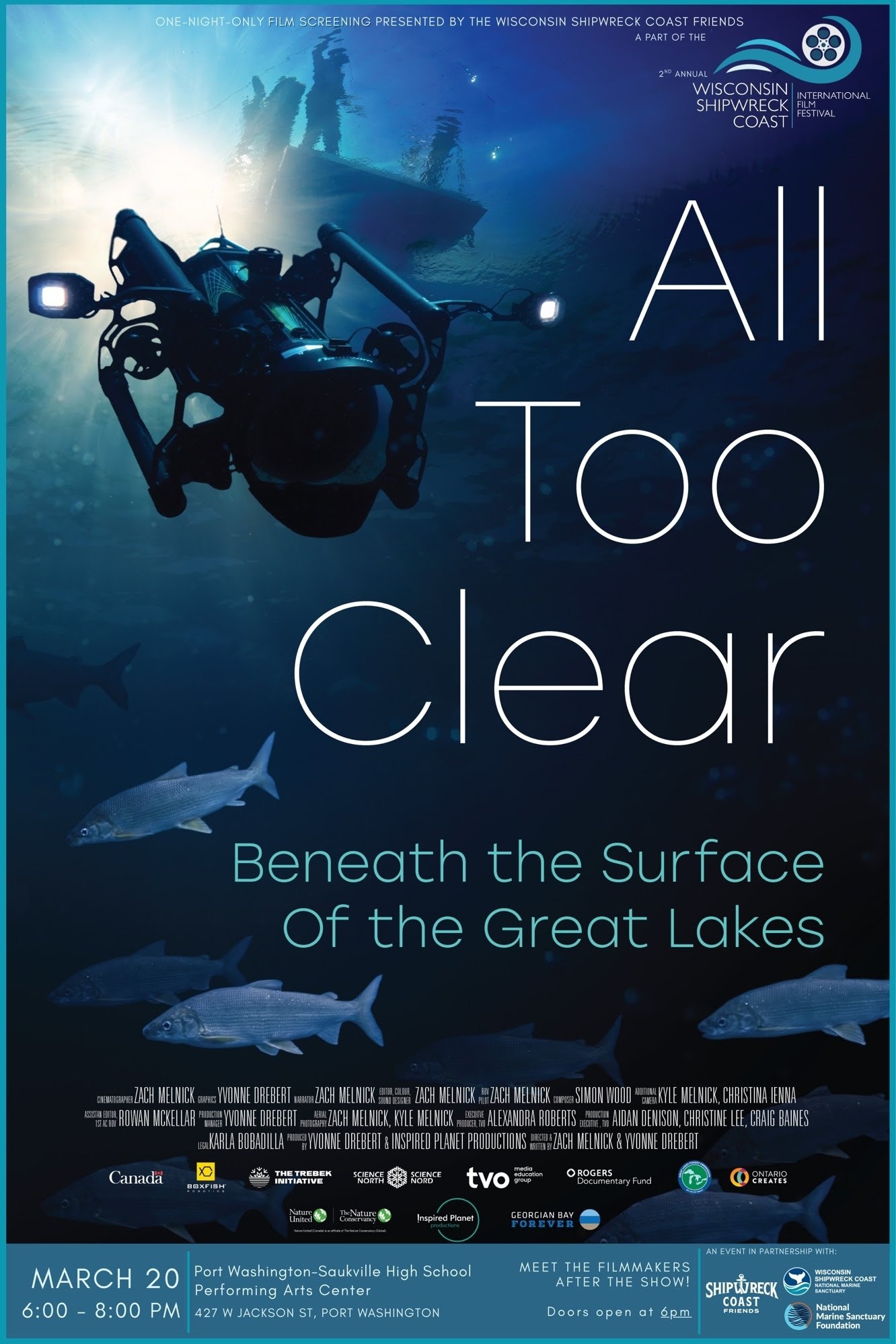
Title: “All Too Clear” Film Screening
Contact: Caitlin Zant, caitlin.zant@noaa.gov, (989) 278-8367
Admission: Free
 
The Friends of Wisconsin Shipwreck Coast National Marine Sanctuary is bringing the underwater world to life if Port Washington, Wisconsin. On March 20th, attendees will be treated to a screening of the acclaimed film “All Too Clear”, by filmmakers Yvonne Drebert and Zach Melnick. The film runs 60 minutes in length and will be followed by a 30-minute talkback and Q & A with the film’s co-director Yvonne Drebert. Refreshments will be offered from Hollander Chocolate Co. & Tulip Cafe.
 
“All Too Clear" uses cutting-edge underwater drones to explore how quadrillions of tiny invasive mussels, known as quaggas, are re-engineering the ecosystem of the Great Lakes at a scale not seen since the glaciers. To capture this epic change, the husband-and-wife filmmaking team of Zach Melnick and Yvonne Drebert spent more than 150 days filming underwater, making it the most ambitious underwater film ever made about the Great Lakes. Part scientific exploration, part natural history adventure – the film showcases freshwater wildlife and environments like never before.
 
The event is hosted in collaboration with the Wisconsin Shipwreck Coast National Marine Sanctuary, International Ocean Film Festival, and National Marine Sanctuary Foundation.
 
Website: shipwreckcoastfriends.org
Host: Wisconsin Shipwreck Coast Friends
Venue: Port Washington – Saukville High School Performing Arts Center, 427 W Jackson St, Port Washington
Date & Time: March 20, 2026 | Doors open at 6 p.m. for refreshments. Film and talk back run from 6:30 to 8 p.m.

View Event →

Sep
17
7:00 PM19:00

Native American Ethnobotany in Basketry, Birch-Quillwork, and Fibers

  • Horicon Marsh Education and Visitor Center (map)
  • Google Calendar ICS

Join us Wednesday September 17, at 7pm for our Rock River Archeology Society Meeting. All programs are free and open to the public.  The meeting is open to the public and is held at the Horicon Marsh Education and Visitor Center located at N7725 Highway 28, Horicon, WI.

Introducing upcoming presenter Lee Olsen who will be presenting on Native American Ethnobotany in basketry, birch-quillwork, & fibers.

View Event →
Feb
28
to Mar 1

Ghost Ships Festival

  • Inn on Maritime Bay (map)
  • Google Calendar ICS

The Wisconsin Underwater Archeology Association is proud to announce the 2025 Ghost Ships Festival on Friday, February 28th and Saturday, March 1st in Manitowoc, Wisconsin at the Inn on Maritime Bay.

The event, originally held in Milwaukee from 2000 to 2017, is a community gathering for those interested in the thousands of historic lost ships that lie on the bottom of the Great Lakes.  This year's Ghost Ships Festival will feature 3D tours of newly discovered Great Lakes shipwrecks using the latest virtual reality headset technology as well as an opportunity to Pilot ROVs (Remote Operated Vehicles) over a “shipwreck” in the event center’s pool.

This year’s festival will also highlight the 50th anniversary of the loss of Edmund Fitzgerald in 1975 and will feature live music, presentations by underwater archaeologists, shipwreck hunters, documentary producers.  It will culminate in the reveal of a major new shipwreck discovery on Lake Superior.

The festival will also feature merchandise booths and exhibits from regional artists, musicians, authors, historians, underwater archaeology programs, dive shops, dive charters and dive clubs.

Admission to the Friday night programs will be free to the public courtesy of the Wisconsin Shipwreck Coast National Marine Sanctuary, but registration is required for the main show on Saturday.  

The public is encouraged to attend and pre-registration for the full event can be made online at ghostshipsfestival.com. Pre-registration tickets are $25 each for the full two-day event, or $30 at the door. Youth under 18 will be admitted for free!

View Event →
Nov
12
7:00 PM19:00

Robert Ritzenthaler November Archaeological Society Meeting

November Meeting: The November meeting of the Robert Ritzenthaler Archeological Society will be held on Tuesday evening, November 12, 2024 at 7 pm in Halsey Hall 228 at UW-Oshkosh.

Speaker: Dan Seurer

Title: “History and Archeological Potential of Wisconsin Lime Production Facilities”

Abstract: Wisconsin has a long history in the production of lime and related products. With easy access to high quality dolostone (a variant of limestone), the state was well positioned for producing lime for the construction and paper making industries. In the early 20th century, Wisconsin was the third largest producer of lime and Wisconsin’s Western Lime and Stone was the largest such company in the United States. In this presentation, we will focus on the history of lime production from the region around Lake Winnebago and the Fox Valley area. Early lime production from places such as Fort Howard through the small pre-industrial era facilities through to the larger industrial size plants will be covered. Finally, we will discuss the archeological potential of the early lime facilities, including how to identify potential unknown kilns through examination of literature and historical maps and field surveys.

Other upcoming presentations:
Tuesday, December 10, 2024: Dr. Seth Schneider, UW-Milwaukee, Pratt Trail in Menominee Park

View Event →
Sep
25
7:00 PM19:00

Rock River Archaeology Presentation

The Speaker will be Melanie Radzicki McManus. She is the author of the memoir Thousand-Miler: Adventures Hiking the Ice Age Trail published by the Wisconsin Historical Society Press, 2017. She will talk about her record-setting trek along the 1,200-mile Ice Age National Scenic Trail. She will also speak about the history of the National Scenic Trail system and how the Ice Age Trail came into being. She also wrote "100 Things to do in Wisconsin Dells Before You Die". Both books will be available for purchase after her talk.

View Event →
2024 Field Assembly at High Cliff State Park
Jul
20
10:00 AM10:00

2024 Field Assembly at High Cliff State Park

Free to the public!

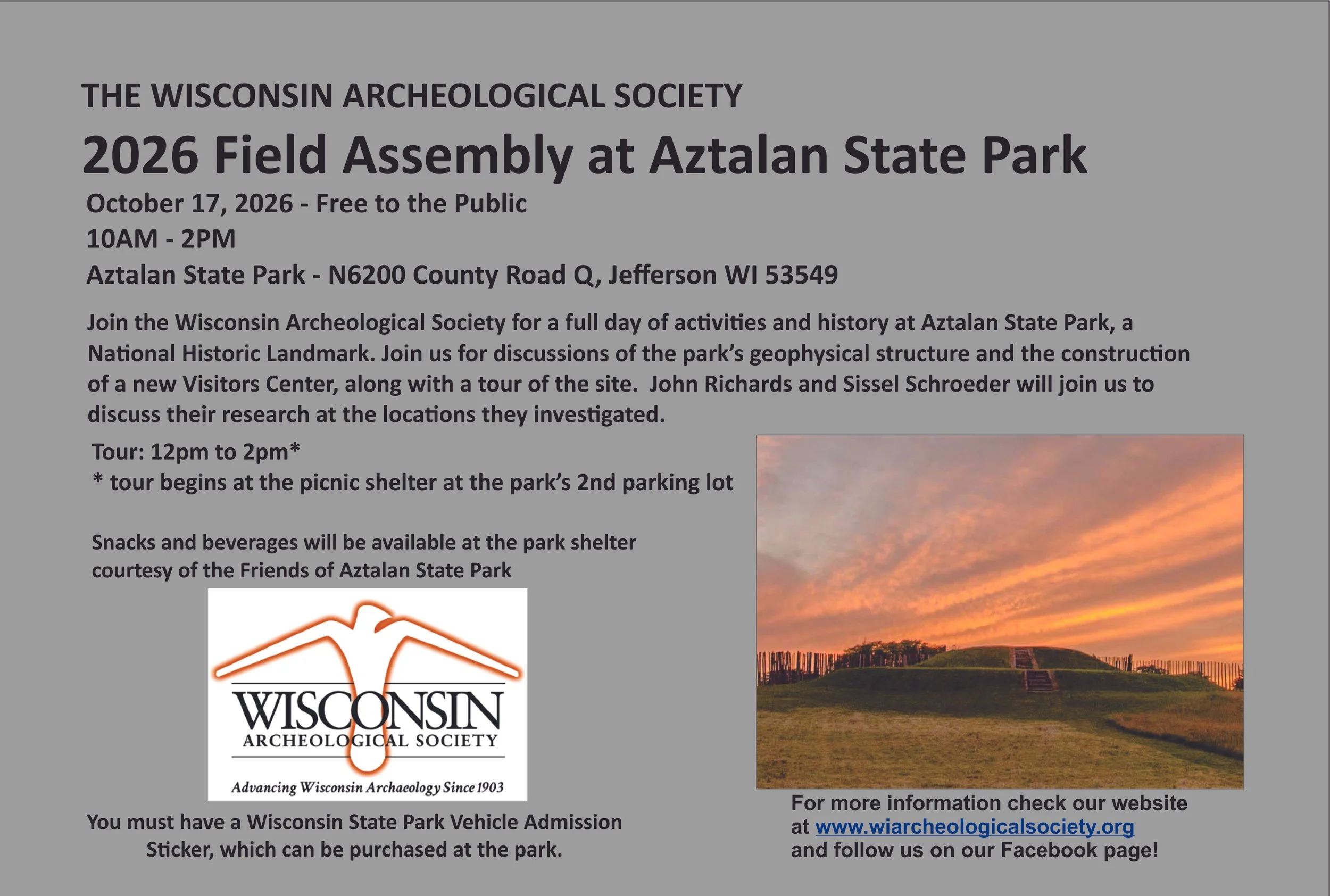
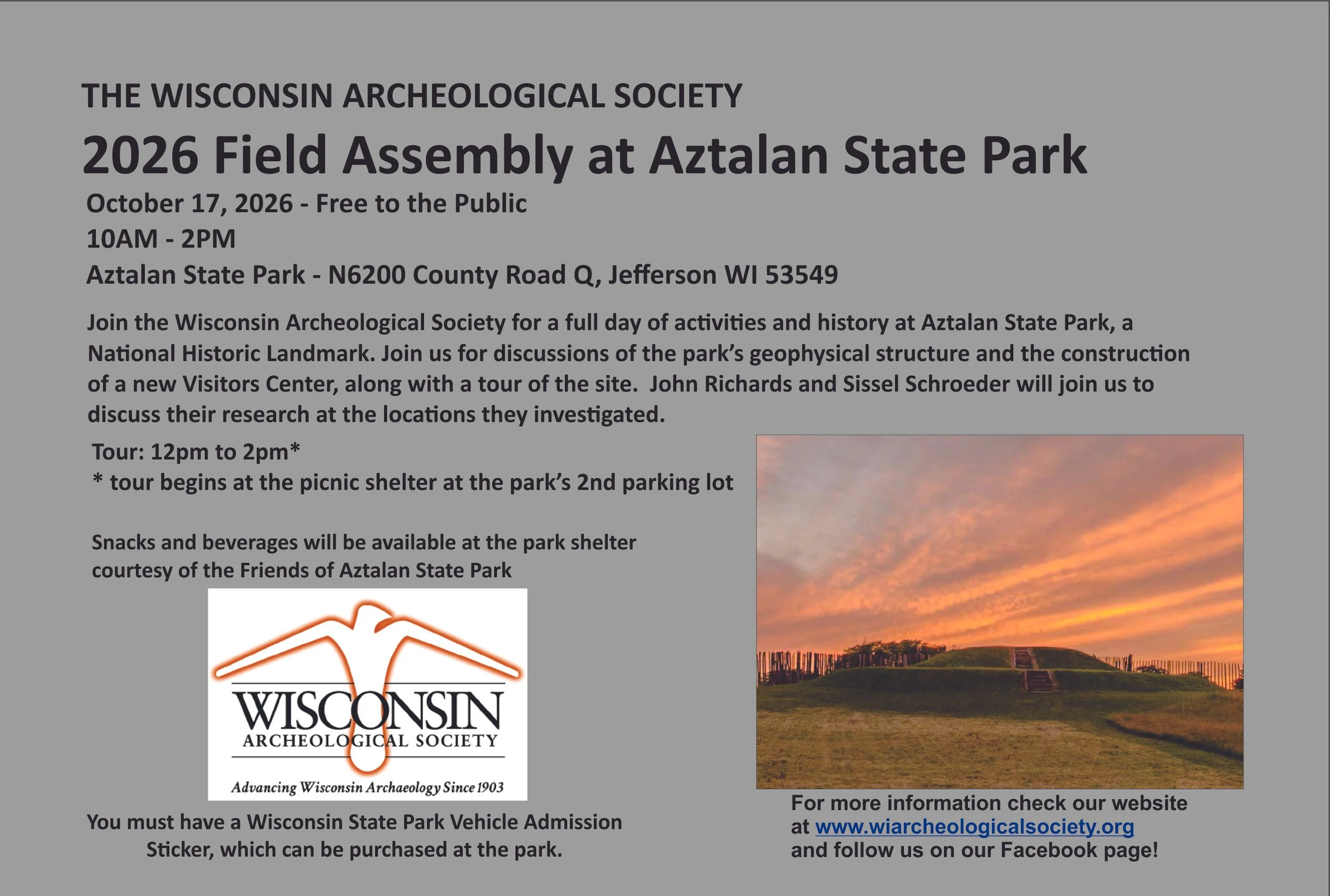
Join the Wisconsin Archeological Society for a full day of activities for adults and children at High Cliff State Park on the north end of beautiful Lake Winnebago. Join us for presentations on the lime kiln ruins and tours of the mounds. In addition there will be activities throughout the day oriented toward understanding the local history, fundamentals of archaeology, and artifact identification. There will be activities geared toward children.

View Event →
Mar
12
7:00 PM19:00

Society Affiliate: Robert Ritzenthaler Archeological Society March Meeting

Speaker:
Dr. Richard W. Edwards, IV

Title: There’s No Place Like Home: An Investigation of Oneota Houses

Abstract: Houses are often central locations for social and economic behavior. Anthropologists often center their studies on houses and households because their design and layout, individually and collectively, can provide insights into the culture and daily life of the people of a given community. This was as true a thousand years ago as it is today, though the study of ancient houses is often hampered by incomplete structures and limited excavation. This talk describes what is known about houses in what is now Wisconsin during the Late Precontact (ca. AD 1100-1400) period and discusses what these structures tell us about these ancient communities.

Click here for more information!

View Event →