
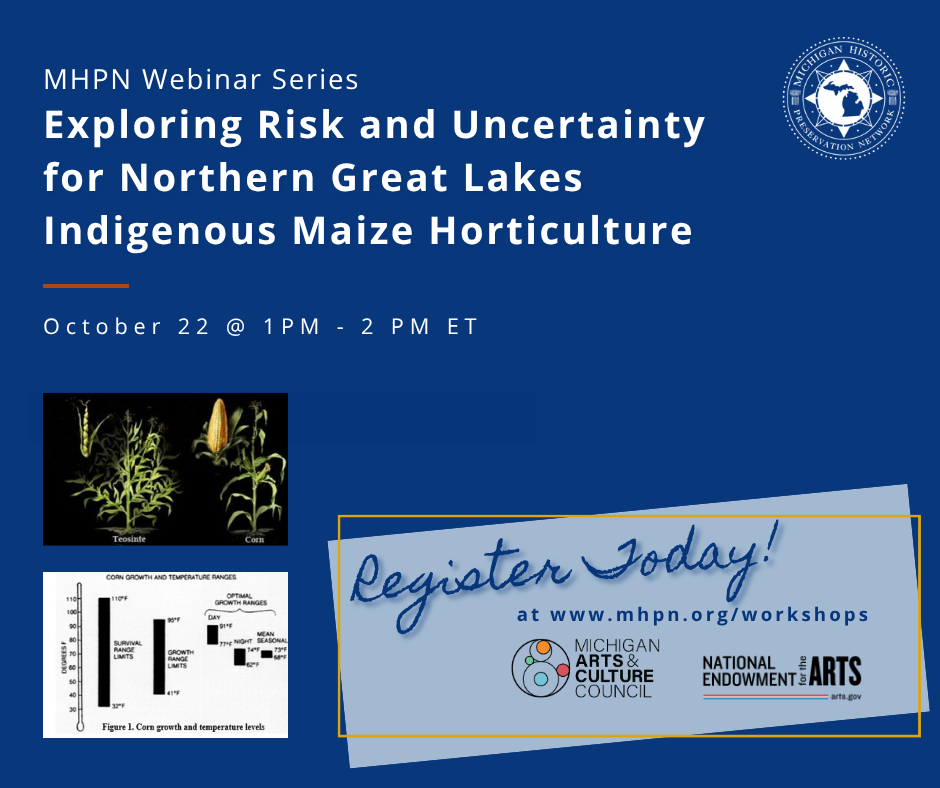
Presenter: Dr. William A. Lovis (emeritus professor and curator of anthropology, Michigan State University
Lecture Abstract:
The risks and uncertainties of indigenous maize horticulture in the northern Great Lakes region (above ⁓45°N Latitude) are explored across the late Holocene climatic episode known as the Little Ice Age (LIA; ca 1300 to 1850 CE/AD), focusing on the 450-year period prior to ca. 1750. Botanical evidence reveals maize presence in the northern Great Lakes 2500 years ago but is not well represented as macro botanical remains and evident in dietary isotopes until ca. 1000 years ago. The same cannot be said for beans or squash. Various mechanisms for food production and its use, enhancement and distribution are evident by at least ca 1000 years ago in the form of ridged agricultural fields, sophisticated subterranean storage facilities, nixtamalization and enhanced landscape locations for intergroup exchange. Archaeologists have successfully pursued and elucidated these phenomena, but have not regularly evaluated the agricultural risks inherent during a period of substantial cooling that wreaked enormous impact on other locations in the northern hemisphere. LIA temperatures are estimated to have cooled by 1 to 1.5 degrees or even as much as up to 3 degrees Celsius, no doubt reducing growing season length. We are stymied by a lack of comprehensive information on drought and pluvial cycle incidence, duration and intensity. This presentation has no clear conclusion but rather is a thought experiment. The exploratory perspective taken here draws on advances in dendrochronology, fire history research, isotopic analysis, pollen studies, etc. to refine understanding of the potential degree of risk for maize production in these northern domains and its relative consistency or ubiquity.
The webinar is free, but registration is required. Register at https://www.mhpn.org/workshops/